
Most businesses struggle to reach the right audience at the right time, wasting money on campaigns that barely convert. The solution is AI in digital marketing a way to automate campaigns, predict customer behavior, and deliver highly personalized experiences that drive engagement and ROI. With AI tools, marketers can finally turn data overload into actionable insights and make smarter decisions in real time.
What Is AI in Digital Marketing?
Artificial intelligence in marketing refers to the use of machine learning, data analysis, and automation tools to improve marketing performance.
In simple terms, AI studies customer data, identifies patterns, and then helps marketers make better decisions.
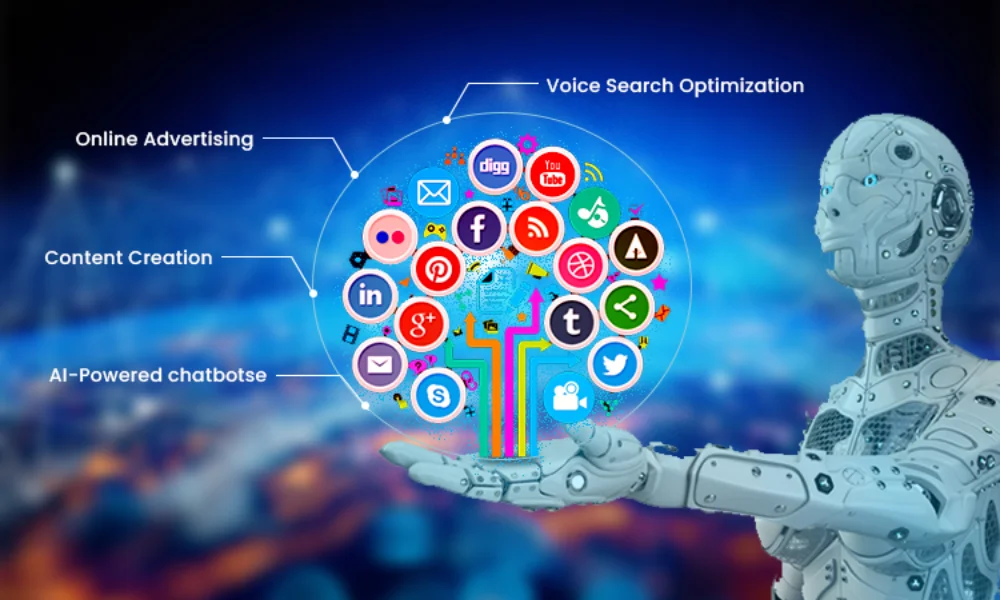
For example, AI systems can:
Analyze consumer behavior
Predict purchasing trends
Personalize product recommendations
Optimize ad targeting
Automate repetitive marketing tasks
At the same time, AI continuously learns from data. So, campaigns become smarter with every interaction.
How AI Works in Marketing Campaigns
AI marketing systems usually follow a structured process.
Data Collection
AI gathers customer data from websites, apps, and social platforms.Pattern Recognition
Algorithms identify behavioral patterns.Prediction
AI forecasts customer actions and preferences.Automation
Marketing tasks are executed automatically.
Because of this process, companies can run campaigns that adapt to customer behavior in real time.
Why AI in Digital Marketing Is Transforming Marketing
AI is reshaping digital marketing because it enables brands to understand audiences in ways that were impossible before.
At the same time, AI removes manual work from marketing teams.
Key Benefits of AI in Digital Marketing
Faster campaign optimization
Accurate customer segmentation
Personalized marketing experiences
Better marketing ROI
Improved customer engagement
In fact, recent industry reports show that over 80% of marketers now use AI-powered tools in their campaigns.
AI Marketing Strategy Framework
Many articles mention AI tools, yet very few explain how to actually build an AI marketing strategy. That said, successful companies often follow a structured framework.
Step 1: Collect Customer Data
First, marketers gather customer information such as:
Browsing behavior
Purchase history
Search queries
Social media interactions
The richer the data, the smarter the AI insights.
Step 2: AI Customer Segmentation
Next, AI tools divide audiences into highly specific groups.
For instance:
| Segment | Example |
|---|---|
| Behavioral segment | Frequent online shoppers |
| Demographic segment | Young professionals |
| Interest-based segment | Fitness enthusiasts |
Because segmentation becomes more accurate, marketing messages become more relevant.
Step 3: Predictive Analytics
Now AI predicts customer actions.
Examples include:
Which customers will purchase soon
Which users might abandon carts
Which audiences respond best to ads
As a result, marketers can prioritize the most valuable leads.
Step 4: Personalized Campaigns
Once insights are ready, AI enables personalized marketing.
Examples include:
Product recommendations
Personalized emails
Dynamic website content
Netflix and Amazon are well-known for using this strategy.
Step 5: Campaign Optimization
Finally, AI monitors campaign performance and automatically adjusts:
Ad bids
Targeting parameters
Content recommendations
So, campaigns keep improving without constant manual changes.
How AI Is Used in Digital Marketing
AI applications appear across nearly every marketing channel.
AI in Content Marketing
AI helps marketers create and optimize content faster.
Key capabilities include:
Keyword research automation
Content topic discovery
AI-assisted writing
SEO optimization
For example, many companies now use AI tools to generate content outlines and analyze search intent.
AI in SEO
AI is transforming search engine optimization. Some common AI SEO applications include:
Keyword clustering
Search intent analysis
Content optimization
Competitor analysis
SERP prediction
Because AI processes huge datasets quickly, SEO strategies become far more data-driven.
AI in Paid Advertising
Paid advertising platforms increasingly rely on AI. Examples include:
Google Ads Smart Bidding
Meta AI ad targeting
Automated budget allocation
At the same time, AI analyzes performance data and adjusts campaigns instantly.
AI in Email Marketing
AI also improves email marketing performance. Common applications include:
Automated subject line optimization
Predictive send times
Customer segmentation
Personalized recommendations
Because emails become more relevant, open rates and click-through rates improve.
AI Marketing Tools
AI marketing tools help businesses automate tasks and gain deeper insights.
Below is a comparison of widely used AI marketing tools.
| Tool | Use Case | Key Feature |
|---|---|---|
| ChatGPT | Content generation | AI writing assistance |
| Jasper | Marketing copy | Brand voice optimization |
| Surfer SEO | Content optimization | AI-driven SEO scoring |
| HubSpot AI | Marketing automation | CRM integration |
| AdCreative AI | Ad design | AI-generated ad creatives |
These tools help marketers save time while improving campaign performance.
AI Marketing Examples
Real-world case studies show how companies successfully use AI.
Netflix Personalization Engine
Netflix uses AI algorithms to recommend shows based on:
Watch history
Viewing patterns
User preferences
In fact, personalized recommendations drive the majority of Netflix viewing activity.
Amazon Recommendation System
Amazon’s recommendation engine analyzes:
Past purchases
Product searches
Browsing behavior
As a result, customers see highly relevant product suggestions. This AI system generates a large percentage of Amazon’s revenue.
Spotify AI Recommendations
Spotify uses AI to build personalized playlists like:
Discover Weekly
Daily Mix
Because the algorithm understands listening patterns, users receive highly relevant music suggestions.
AI Chatbots in Customer Support
Many companies deploy AI chatbots for customer service.
Examples include:
Website support bots
Automated product assistance
AI-powered FAQ systems
These chatbots handle routine queries instantly.
AI Trends Digital Marketing
AI continues to evolve rapidly, and several important AI trends in digital marketing are shaping the industry. AI predicts how customers move through the buying process. As a result, marketers can target users at the perfect moment.
Hyper-Personalization
AI now enables personalization at scale.
For example:
Dynamic website experiences
AI-generated email content
Personalized product offers
Customers feel like brands understand their preferences.
AI Marketing Automation
Automation is becoming smarter.
Instead of simple workflows, AI systems now manage:
Campaign performance
Audience targeting
Budget allocation
Because of this, marketing teams focus more on strategy.
AI Content Creation
AI-generated content is becoming increasingly common.
Marketers now use AI for:
Blog outlines
Social media captions
Ad copy
Product descriptions
That said, human editing still plays an important role in maintaining authenticity.
Challenges of AI in Marketing
Despite its advantages, AI also brings challenges.
- Data Privacy Concerns: Customer data collection must follow privacy regulations. Companies must ensure transparency and compliance.
- AI Bias and Accuracy: AI models sometimes produce biased or inaccurate results. Because of this, marketers must monitor AI outputs carefully.
- Over-Automation Risks: Too much automation can reduce human creativity.
Successful marketing strategies usually combine AI insights with human judgment.
Practical Tips for Implementing AI in Digital Marketing
Businesses adopting AI should start strategically. Here are some key implementation tips:
Begin with small AI projects
Focus on data quality first
Choose tools that integrate with existing platforms
Monitor AI performance regularly
Combine AI insights with human creativity
These practices help companies maximize the benefits of AI marketing.
Conclusion
AI in digital marketing is transforming how businesses reach and engage customers. From predictive analytics to personalized campaigns, AI allows marketers to make smarter decisions and deliver better experiences.
At the same time, companies that adopt artificial intelligence early gain a strong competitive advantage. As AI tools continue evolving, marketers who combine technology with creativity will lead the future of digital marketing.
FAQs
What is AI in digital marketing?
AI in digital marketing is the use of machine learning and automation to optimize campaigns, personalize experiences, and analyze customer behavior.
How is AI used in digital marketing?
AI is used for content creation, SEO optimization, predictive analytics, paid advertising, and email marketing personalization.
What are examples of AI in marketing?
Netflix recommendations, Amazon product suggestions, Spotify playlists, and AI chatbots are real-world examples.
What are the benefits of AI marketing tools?
They save time, improve targeting, enhance personalization, and increase marketing ROI.
What are AI trends digital marketing businesses should know?
Predictive customer journeys, hyper-personalization, automation of campaigns, and AI-assisted content creation are top trends.