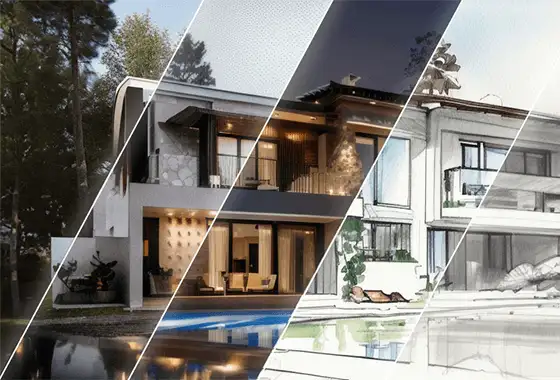
The world of 3D graphics and spatial design has reached an evolutionary tipping point. The conversation has officially shifted from traditional, linear computational pipelines to neural rendering a technique where machine learning models predict how light, physics, and complex materials interact within a simulated environment. For architects, digital marketers, and spatial designers, this transition isn’t just a basic speed upgrade; it is a fundamental restructuring of the creative process.
When platforms calculate visual outputs using deep neural networks instead of calculating individual photon paths one by one, production bottlenecks completely disappear. This comprehensive industry analysis deep-dives into the inner mechanics of rendering AI, maps out the dominant enterprise tools, and provides a clear guide on how to integrate these workflows into your creative pipeline.
Why Generative Rendering is a Strategic Asset
Traditional rendering was notoriously linear. One change to a light source meant hours of recalculation. Today, a specialized family entertainment center marketing agency can use real-time AI rendering to show clients immersive 3D walkthroughs of park layouts during the first pitch. This immediate feedback loop eliminates the “patience test” of old-school design, allowing for rapid iteration that was previously impossible.
Rendering AI isn’t just for design veterans. It’s a breakthrough for everyone: students, freelancers, agencies, and architects. And in 2025, it’s becoming the go-to tool for fast and stunning visuals.
Defining Rendering AI in the LLM Era
To understand why legacy software is losing market dominance, we must examine the underlying technology. Traditional 3D production relies on path tracing or ray tracing highly math-intensive processes that physically trace light beams across a virtual scene. While incredibly accurate, this system requires massive hardware configurations and hours of processing time to resolve noise and shadows.
In contrast, neural rendering AI treats visual generation as an intelligence problem rather than a raw calculation problem. By utilizing advanced latent space structures trained on hundreds of millions of photo-realistic environmental assets, the engine analyzes a simple block model or low-resolution mesh and immediately predicts the final output.
Why Rendering AI Is Taking Over the Design World
Rendering used to be a big headache. Designers would tweak tiny settings for hours, then hit “render” , and wait. If something looked off? Back to square one.
But now, Rendering AI takes the boring part out of the process. It helps you focus on creativity while handling the technical stuff in the background.
Let’s break down the benefits in simple terms:
- Lightning-Fast Results – What once took hours now takes minutes.
- Smarter Outputs – AI learns from millions of designs and adapts to yours.
- More Freedom – Spend less time clicking and more time imagining.
- Beginner-Friendly – No tech jargon or steep learning curves.
- Cost-Effective – Cloud tools mean no fancy equipment is needed.
How Does Rendering AI Actually Work?

Think of Rendering AI like a brain that’s been trained on billions of photos and scenes. It knows what lighting looks like at 5 PM. It understands how sunlight hits glass versus wood. When you give it your design, it guesses what it should look like and builds it in real time.
Here’s a simple breakdown of the process:
- Input: You upload a sketch or 3D model.
- Understanding: The AI recognizes shapes, spaces, and objects.
- Enhancement: It picks materials, lighting, and shadow placement.
- Output: A photo-realistic rendering is generated, ready to share or present.
It’s like going from Lego blocks to a finished model in a single click.
Top AI Rendering Platforms for 2025
Let’s talk tools. These AI-powered render engines are helping teams, students, and freelancers create polished visuals faster than ever.
| Tool | Core Capability | Ideal For |
| D5 Render | Real-time Ray Tracing | Architecture & Large Scale Interiors |
| MyArchitectAI | Structural Visualization | Residential Planning & Blueprints |
| ReRender AI | Generative Concepting | Fast Prototyping & Iteration |
| Runway ML | Video Synthesis | Social media marketing company assets |
Pro Tip: Start with a free trial, test your workflow, then scale up! If you’re also exploring AI for static visuals outside architecture, our comparison of the best AI art generators covers tools built for broader creative and marketing use cases.
Real-World Wins with Rendering AI

Let’s look at how people are using this tech right now.
Architecture Firms
Major firms report up to 50% faster design approvals. Clients understand the vision better when visuals are clear, leading to fewer revisions.
Freelancers
Freelance designers are generating client-ready images in hours, not days. That’s more time to focus on pitching and less on rendering.
Students
Architecture students using AI tools like Lumion or MyArchitectAI say they complete assignments twice as fast , and with higher grades.
Agencies
Marketing teams use Runway ML to visualize ideas for clients overnight. Internal reviews go smoother when everyone sees the concept early. This same acceleration is reshaping other creative workflows too our guide to AI design software covers similar tools being adopted across marketing and branding teams.
What Makes Rendering AI Stand Out?
The best part about using Rendering AI tools in 2025? They make even complex visual work feel effortless. These features take the stress out of rendering and give you back time to create.
Real-Time Edits
With AI-powered real-time rendering, every lighting tweak or texture change shows up instantly on screen.
- You don’t need to hit “render” and wait; what you see is what you get, in real time.
- This feature is perfect for live presentations or last-minute changes before a pitch.
- Tools like D5 Render and Lumion AI excel in this area.
Smart Auto Materials
AI rendering software now suggests the right materials based on your model or layout.
- For example, wood textures for floors or reflective finishes for glass, no manual guesswork needed.
- This means faster styling and more consistent results across your projects.
- It’s especially handy for beginners who aren’t sure which finishes to choose.
Natural Light Simulation
Advanced AI rendering tools can simulate realistic lighting based on time of day or season.
- Want a sunset glow? Morning shadows? Indoor daylight? You can get it with one click.
- This helps architects and designers show clients exactly how spaces will feel.
- Lighting accuracy is key for mood, realism, and even safety in certain designs.
Prompt-to-Scene Rendering
Type a sentence like “modern kitchen with natural lighting and marble countertops”, and boom, get a fully rendered scene.
- This text-to-render feature saves hours of modeling and layout time.
- It’s especially useful for fast concept testing or when you need visuals in a pinch.
- Tools like ReRender AI lead in this space, making creativity as easy as writing a sentence.
AI Noise Reduction
Some renderings start out rough or grainy, especially if you’re using low-res inputs. But AI denoising algorithms automatically clean things up, giving you sharp, professional images.
- This boosts quality without the need for re-rendering or post-editing.
- It’s a lifesaver for students, freelancers, and teams on tight deadlines.
Step-by-Step: How to Use Rendering AI (Even If You’re New)
Transitioning to an AI-accelerated rendering pipeline is highly straightforward, even if you are transitioning from a legacy drafting background.
Industry Stats That Say It All

68% of Design Firms Use AI Tools
A 2025 survey from ArchTech Global found that 68% of architecture and design firms now use AI rendering software. This aligns with broader findings from the American Institute of Architects, which has tracked accelerating technology adoption across the profession in recent years.
90% Faster Rendering Times
Designers using AI-powered tools report a 90% reduction in rendering time compared to traditional methods.
What used to take hours (or even overnight) now finishes in just minutes.
This means faster project cycles and more time for creative iteration.
Freelancers Gain a Competitive Edge
About 2 in 5 freelancers say they’ve won more clients because of AI rendering.
Being able to deliver impressive visuals quickly sets them apart from others.
Faster delivery = happier clients + repeat business.
Where Rendering AI Is Headed in the Future
AI rendering isn’t just a passing trend; it’s evolving fast. Here’s what’s on the horizon:
Integration with VR and AR
Imagine walking through your design using a VR headset, powered by AI-rendered environments.
Rendering AI is being integrated into virtual and augmented reality platforms.
This will allow clients to “step inside” a space before it’s built.
It’s the future of immersive presentations, especially in real estate and architecture.
Smarter AI Learning from Your Projects
As you use AI tools, they learn your preferences , favorite materials, lighting styles, design flow.
Future platforms will offer personalized rendering recommendations tailored to your style.
Think of it as a rendering assistant that evolves with you.
Voice-to-Render AI Capabilities
Soon, you might just describe your idea out loud , and the AI will create it on the spot.
“Design a Scandinavian living room with wood floors and big windows,” and voilà.
Voice-controlled rendering could make visual design even more accessible to non-designers.
Better Plugin Support for CAD/SketchUp
Expect smoother integrations with CAD software, SketchUp, and even BIM platforms.
This means fewer file conversions, quicker workflow, and better rendering results.
A seamless pipeline from design to visualization will be the new normal.
Final Thoughts: Rendering AI Is the Future of Visual Design
The rise of advanced rendering AI does not mark the end of the traditional designer; instead, it marks the end of administrative production bottlenecks. By offloading time-consuming lighting and pixel calculations to highly trained neural engines, creative professionals gain unparalleled freedom to focus on conceptual depth, environmental sustainability, and pure human spatial strategy.
As the technology continues to advance, individuals and studios that embrace these platforms will consistently outperform those bound to legacy compute models. Embrace the competitive advantage, streamline your digital creative assets, and build the future of visual media with the authoritative industry insights provided by Updatednetworth.
FAQs (2026 Industry Standards)
1. What exactly makes neural rendering faster than traditional rendering?
Traditional rendering methods require computers to calculate every individual bounce of light off every virtual object in a scene. Neural rendering bypasses this brute-force calculation by using deep learning models that look at your geometry and immediately predict what the finalized, photorealistic light and shadow placement should look like based on extensive training data.
2. Do I need an expensive workstation computer to run modern AI rendering software?
No. The vast majority of 2026 rendering AI platforms operate via cloud infrastructure. Because the complex neural network processing is handled on remote server farms or dedicated cloud tensor networks, you can easily generate high-fidelity 3D concepts using a standard laptop with a stable internet connection.
3. How does prompt-to-scene rendering work in practice?
Prompt-to-scene engines utilize natural language processing models linked directly to spatial layout tools. When you type a phrase like “modern minimalist kitchen with white marble countertops,” the AI identifies the structural boundaries of your model and automatically applies the corresponding high-resolution textures and lighting styles without manual mapping.
4. Can rendering AI work directly with traditional CAD and SketchUp files?
Yes. Modern AI rendering engines feature seamless plugin support for industry-standard CAD, BIM, and drafting software like SketchUp, Revit, and Rhino. This eliminates the need for tedious file format conversions and allows changes made in your primary drafting program to update inside the AI visualizer instantly.
5. Will rendering AI completely replace professional 3D designers?
No. While AI handles the mechanical, time-consuming aspects of rendering, image denoising, and basic asset texturing, it cannot replicate human creativity, client empathy, structural problem-solving, or spatial strategy. The technology functions as a highly powerful assistant that allows designers to spend less time waiting on progress bars and more time iterating concepts.